
Mingling with giants at the Giant’s Causeway in Northern Ireland
For years, the Giant’s Causeway was one of those mythical landscapes I only ever encountered on rotating desktop screensavers or in sweeping BBC nature documentaries. It felt so alien and impossibly sculpted that I never genuinely pictured myself standing on top of it.
Yet, there I stood on day six of my road trip along Northern Ireland’s Causeway Coastal Route with Shamrocker Tours, bracing against the gale-force Atlantic wind while sea spray crashed over thousands of jet-black, geometric stone columns. It quickly became the undisputed highlight of my trip for two reasons: the sheer cinematic drama of the Antrim coastline, and the fact that its geological origin story comes wrapped in one of the funniest pieces of Irish folklore I’ve ever heard.
Because if there’s one golden rule you learn traveling through Ireland, it’s this: never let dry science get in the way of a brilliant pub tale.
The legend of Finn MacCool and the Causeway Coast

According to local Gaelic mythology, these interlocking basalt columns weren’t forged by the Earth at all—they were laid stone by stone by the legendary Irish mythological hero, Finn MacCool (Fionn mac Cumhaill).
As our guide recounted with theatrical flair, a rival Scottish giant named Benandonner challenged Finn to a duel across the North Channel. Eager to settle the score, Finn built a massive highway across the sea to bridge the gap between County Antrim and Scotland. But as Benandonner stomped across the water, Finn caught one glimpse of him and froze: the Scottish brute was twice his size.
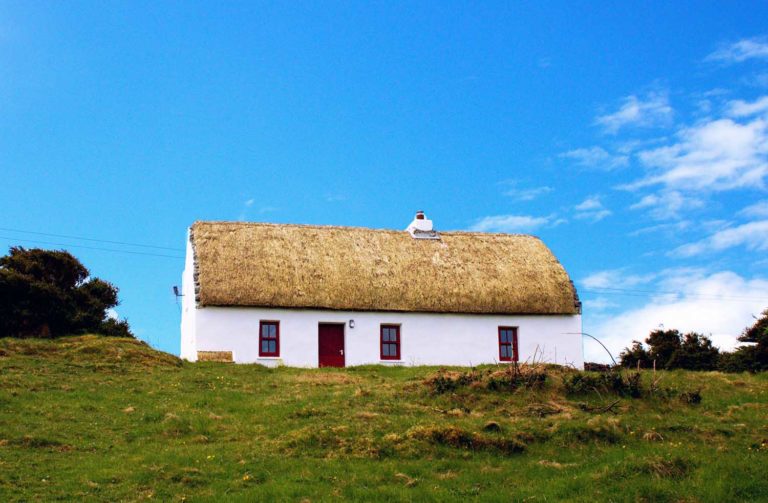
Terrified and hopelessly outmatched, Finn bolted back to his cottage on the Antrim cliffs and threw himself at the mercy of his clever wife, Oona (Oonagh).
Instead of letting him face certain doom, Oona orchestrated a masterclass in psychological warfare. She wrapped the burly Irish giant in swaddling cloths, shoved him into an enormous wooden cradle, and waited for Benandonner to kick down the door.
When the Scottish giant stormed inside ready for blood, he found Oona shushing him so as not to wake the sleeping “infant.” Benandonner stared at the monstrous baby in sheer horror, his logic spinning: If the newborn child is this colossal, how terrifyingly massive must the father be?!
Spooked to his core, Benandonner turned on his heel and fled straight back across the Irish Sea, tearing up the stones behind him so Finn couldn’t pursue him. (Fun fact: Fingal’s Cave across the water on Scotland’s Isle of Staffa features the exact same basalt formations, giving believers all the proof they need).
You truly have to respect that level of classic Irish wit.
How was the Giant’s Causeway actually formed?

Of course, if you step inside the modern National Trust Visitor Centre, geologists will hand you a rather different explanation.
Around 50 to 60 million years ago, during the Paleocene Epoch, intense volcanic activity tore through County Antrim. Molten basalt lava pushed up through porous chalk beds, forming an expansive volcanic plateau. As that massive pool of lava cooled slowly and evenly, it contracted horizontally and cracked into roughly 40,000 interlocking polygonal columns—a fascinating geological phenomenon known as columnar jointing.
Mention that to a local in the nearby village of Bushmills, though, and they’ll playfully brush it off. Volcanoes in modern Ireland? Ridiculous. Giants? Entirely plausible.
Today, this UNESCO World Heritage Site remains Northern Ireland’s most visited natural attraction and a crown jewel of the UK’s natural wonders.
Scrambling across the stones myself, the sheer symmetry felt completely surreal. While the vast majority of the pillars are crisp hexagons, as I looked closely beneath my hiking boots, I spotted pillars with four, five, seven, and even eight distinct sides. Some of the tallest basalt columns soar nearly 12 meters (almost 40 feet) into the salty air, set against solidified volcanic cliff faces rising 28 meters thick.
Standing on those ancient stepping stones with the salty foam spraying my face, looking straight out across the gray horizon toward Scotland, I couldn’t help but smile. In a landscape this dramatic, it feels far more fun to believe in giants.