Delft, the quintessential Dutch town
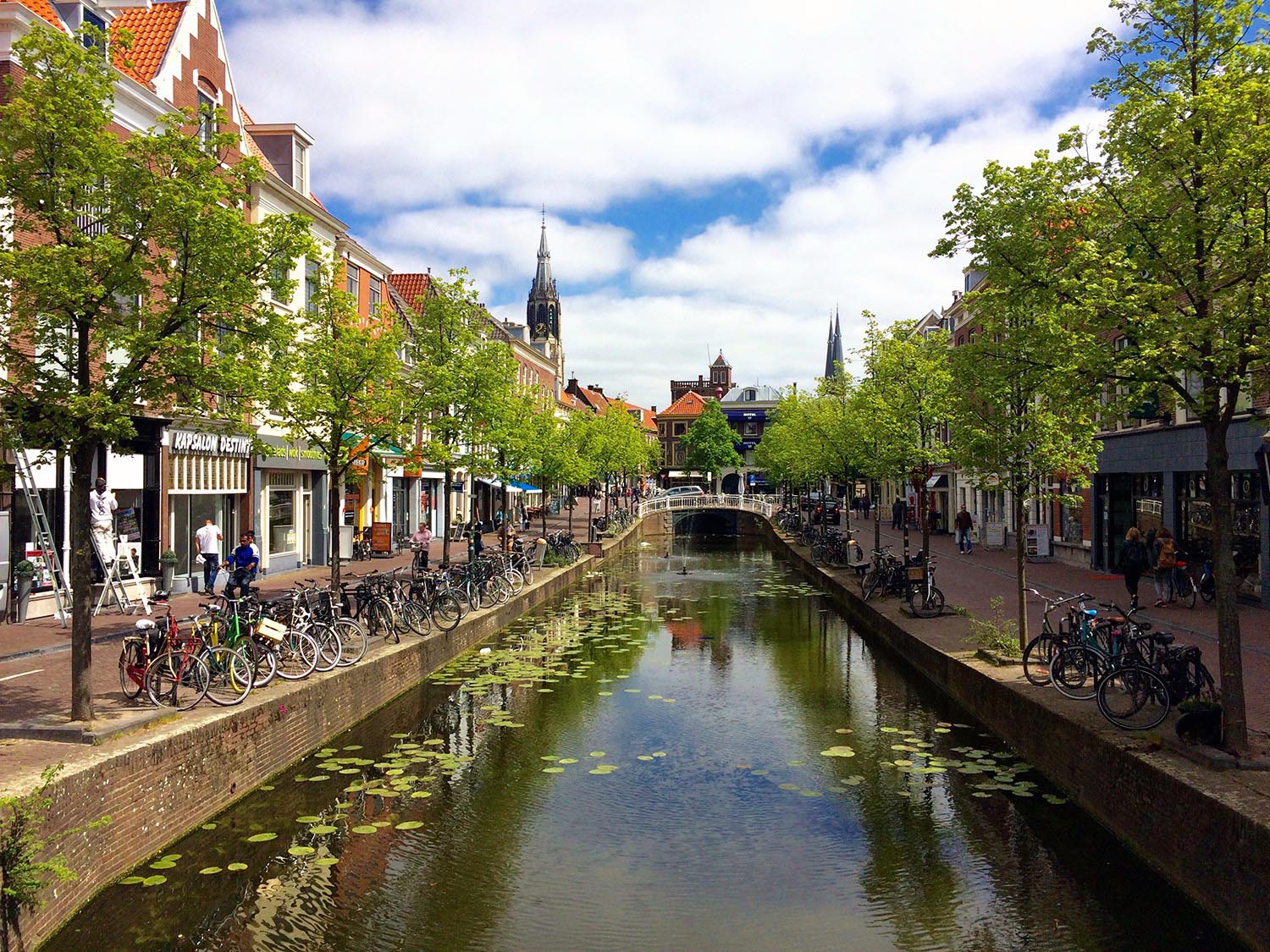
The chime of bicycle bells and the soft slap of water against mossy canal walls were the first sounds that greeted me as I stepped out of Delft’s modern glass-and-steel station. Just forty-five minutes earlier, I had been navigating the frantic energy of Amsterdam Centraal. Here, barely fifty miles south, the tempo of the Netherlands seemed to drop by half.
I’ve always had a soft spot for Dutch canal towns that slip out from the shadow of the capital, and a day trip to Delft felt like stepping into an intimate Golden Age painting where modern life merely hums quietly in the background.
Canals, cobblestones, and Johannes Vermeer


You can’t set foot in Delft without immediately sensing Johannes Vermeer’s ghost lingering around every corner. While the rest of the 17th-century Dutch masters chased commissions across Europe, Vermeer barely ever left these city walls. He lived, loved, struggled, and died right here, walking the exact same brick-paved alleys I was wandering.
Strolling along the Oude Delft—the city’s 11th-century canal—the penny suddenly dropped. Morning light was slicing through the linden trees, shimmering off the dark canal water and catching the crooked facades of 400-year-old row houses leaning tipsily into one another. It hit me instantly: Vermeer didn’t conjure that buttery, hypnotic glow from thin air. He simply poured his morning coffee, glanced out his window, and painted what was already there.
Ironically, not a single one of his original masterpieces remains in Delft—they’re hoarded by the Rijksmuseum, the Mauritshuis, and the Met. But ducking into the Vermeer Centrum Delft on Voldersgracht made up for it.
Climbing towers and finding royalty


Crossing an arched footbridge brought me to the expansive Markt, one of the grandest public squares in the country. Anchoring one end sits the stately, Renaissance-style City Hall (Stadhuis), while towering opposite is the dramatic, Gothic spire of the Nieuwe Kerk (New Church).
Despite its name, construction on the “New” Church began in 1381. It serves as the final resting place of the Dutch Royal Family, housing the ornate marble crypt of William the Silent, the founding father of the Dutch Republic who was assassinated in Delft in 1584.
I paid the modest admission fee and began the breathless 376-step spiral climb up the church tower. It is not for the faint of heart—or the claustrophobic. But emerging onto the observation platform repaid every burning quad muscle! On a clear day, the flat Dutch lowlands stretch infinitely on to panoramic views. You can easily spot the modern skyline of Rotterdam to the south and the high-rises of The Hague to the north.
After descending, I strolled a few blocks northwest to the Oude Kerk (Old Church). Nicknamed Scheve Jan (“Crooked John”), its massive 75-meter stone tower leans alarmingly toward the canal beside it—over two meters off-center, courtesy of unstable soil during its 14th-century construction. Inside lies Vermeer’s modest, poignant burial marker, quiet and reverent beneath soaring whitewashed arches.
The world of Delft Blue

No visit to this corner of South Holland would be complete without encountering Delftware (Delfts Blauw). In the 17th century, when trade with China via the Dutch East India Company brought coveted blue-and-white porcelain to European courts, local potters devised a tin-glazed earthenware alternative that became a worldwide sensation.
While souvenir stalls in the Markt overflow with cheap imported trinkets, true artisans still practice the delicate craft. Royal Delft (Koninklijke Porceleyne Fles) is the last remaining earthenware factory from the 1600s. Here, I watched master painters steady their wrists with wooden rests, applying black cobalt-oxide paints that only turn their signature blue after high-heat firing. Holding a finished piece, you realize the intricate cross-hatching isn’t just decoration; it’s four centuries of living heritage.
Where to buy authentic Delft Blue porcelain
- Royal Delft Factory Showroom (Koninklijke Porceleyne Fles) Rotterdamseweg 196 — The ultimate stop. Operating since 1653, it is the sole surviving 17th-century manufacturer. It produces certified, hand-painted earthenware complete with official maker’s marks and certificates of authenticity.
- Royal Delft Brandstore Markt 62–64 — The official town-centre boutique located directly on the central market square. It offers the same certified Royal Delft pieces without having to walk out to the main factory.
- De Candelaer Kerkstraat 15 — A beloved independent artisan workshop right off the Markt where master ceramicists throw, glaze, and hand-paint custom earthenware on-site using traditional historical methods.
- Antiek ‘t Oude Hert Vrouwjuttenland 23 — A reputable canal-side antique dealer specializing in authentic 17th- and 18th-century antique tiles (Delftse tegels), plates, and vintage collector pieces with proven provenance.
- Delft Antiekmarkt (Canal Antique Market) Hippolytusbuurt & Voldersgracht — Open Thursdays and Saturdays (April to October), featuring vetted regional dealers selling genuine antique and mid-century Delftware along the water.
Practical tips for your day trip to Delft

How do I get to Delft by train from Amsterdam, Rotterdam, or The Hague?
Getting to Delft via the Dutch rail network (Nederlandse Spoorwegen/NS) is direct, frequent, and straightforward. Trains run every 10 to 15 minutes. You do not need paper tickets in advance—simply tap your contactless debit card, credit card, or smartphone at the station turnstiles when boarding and exiting (OVpay).
- From Amsterdam Centraal: Direct Intercity trains take roughly 50 minutes.
- From Rotterdam Centraal: Direct trains arrive in about 12 minutes.
- From The Hague (Den Haag Centraal): Direct trains take only 15 minutes.
How much time do you need for a day trip to Delft?
Plan to spend around 5 to 6 hours in Delft. This gives you plenty of time to tour the historic city centre, visit both the Oude Kerk and Nieuwe Kerk, tour the Royal Delft pottery factory, browse canal-side boutiques, and sit down for an authentic Dutch appeltaart or warm stroopwafel.
Is Delft walkable?
Yes, Delft is exceptionally pedestrian-friendly, flat, and compact. You do not need a car or public transit once you arrive at the central station, as the historic core is easily explored on foot (just watch out for cyclists and wear comfortable shoes for the historic cobblestones).
When is the best time of year to visit Delft?
The best time to visit Delft is between April and October, when the weather is mild, canal-side terraces are open, and flowers line the bridges. For the liveliest atmosphere, plan your visit on a Thursday or Saturday, when the city’s central squares host bustling open-air markets selling flowers, fresh produce, and local antiques.